Part 2 of 5 · The digital foundation
Subscriptions that collect themselves — and post to the books in the same place
The treasurer sends invoices, checks the bank account, ticks off the spreadsheet and chases the last twenty by hand. Three of those four steps do not need a human.
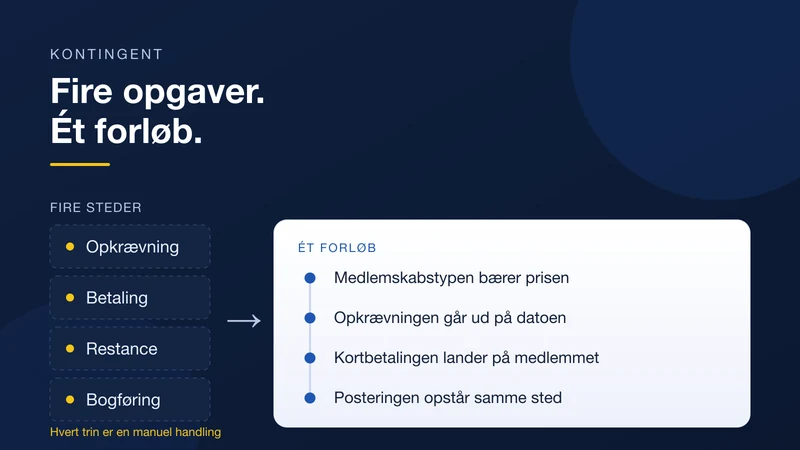
Automatic subscription collection means the price follows the membership type in the register, the invoice goes out on a date the association chose, the payment is recorded against the member the moment it lands, and arrears appear as a list instead of having to be found. The treasurer's job becomes following up on the exceptions — not keeping score of the rule.
This is part 2 of the series on the digital foundation of an association. Part 1 covered the member register, which invoicing reads from.
Where does the time go in a manual subscription season?
Not in the sending. That is one email to everyone. The time goes into what comes after.
Some pay immediately, some pay the wrong amount, some pay without saying who they are, and some do not pay. The treasurer has to match deposits on the bank account against names on a list, and the bank's text field is neither the name nor the membership number. Then arrears have to be found, chased, followed up and ticked off again next week.
That work grows with the square of the number of exceptions, not with the number of members. Which is why an association with 150 members can spend more evenings on it than one with 500.
What has to connect?
Four things, in that order.
The price must come from the membership. Senior, junior, passive and household each have their price, and the price must live in one place so a price increase is not typed in 300 times.
Payment must happen in the system. If the member pays by card on a page the association itself issued, the system knows who paid, what for, and when. That removes the entire reconciliation job.
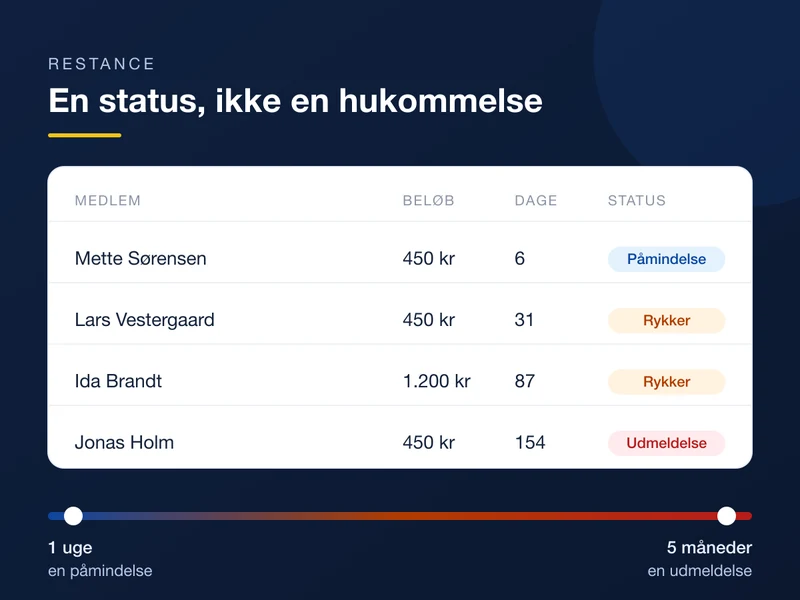
Arrears must be a status, not a memory. A member who has not paid should be visible as exactly that — to the board, not only to the treasurer.
Bookkeeping must derive from the same events. Every payment is a posting, and the posting should originate where the payment happens. See subscriptions and accounts.
What happens when a member does not pay?
In most associations nothing happens for three months, and then something unpleasant happens. Not because the board is harsh, but because nobody could see the arrears until they were old enough to be a problem.
When arrears is a status rather than a hunch, following up becomes a small task instead of a confrontation: a friendly message after a week reaches somebody who forgot. The same message after five months reaches somebody who has stopped turning up.
So decide two things in the board before the season starts: when do we follow up, and what happens in the end. Write it down. Then it is the association's practice and not the treasurer's mood.
When should the subscription be collected?
Before the season, not during it. A member who has paid before the activities begin is also a member who turns up — and an association that has the money before the costs arrive does not have to borrow from next year's budget.
So pick a fixed date and repeat it. That makes the price predictable for members and the invoicing predictable for the treasurer, and it makes it possible to plan the follow-up in advance instead of improvising in November.
Rolling memberships, where payment renews automatically, move the work one step further: then there is no season to invoice, but a state that continues until the member says stop. That is also the model that places the highest demands on making cancellation easy and visible. A membership that is hard to leave costs more in word of mouth than it earns in subscriptions.
Before the next subscription season
- Decide the invoicing date and put it in the annual plan, so it does not depend on when the treasurer has a free evening.
- Review the membership types. Any type without a price becomes an exception later.
- Clear last season's arrears before invoicing the next one. Otherwise the two seasons get mixed together.
- Agree in the board what happens when someone does not pay — and when.
- Send one message about the price and the date before the invoice arrives. It halves the questions.
Note
Subscriptions and sales are the same mechanics
Once payments can be taken in the system, they can also cover more than subscriptions: kit, trip participation, tickets and courses. It is the same payment path and the same bookkeeping, so that income does not need a separate spreadsheet either. See webshop.
Frequently asked questions
Can members pay by card?
Yes. Payment happens on the association's own page and is recorded against the member immediately, so there is no reconciliation against the bank account afterwards.
What about members who prefer a bank transfer?
They can continue, and the payment is recorded manually against the member. The point is that this becomes the exception the treasurer has time for, because the rest runs itself.
Can we see who is in arrears?
Yes. Arrears is a status on the member, so the list is a list — not something to be derived by comparing the bank account with the member list.
What if the price rises in the middle of a period?
Decide whether the change applies from the next invoice or the next season, and announce it before the first new invoice goes out. The price sits on the membership type, so the change is only made in one place.
Can we still use our auditor and our current bookkeeping?
Yes. Payments and postings are captured in one place and can be exported to whatever accounts the association already keeps.
Continue to part 3: sign-ups and booking
Once payment can happen in the system, signing up for an activity and paying for it become the same action. That is part 3.